
You can see the damage.
Peptest helps you find the cause.
A non-invasive saliva test that gives you objective evidence of whether reflux is contributing to erosion in your patients — simple clinic workflow, clinician-ready results from our UK laboratory.
Clinic account · Pricing on application · No setup fees · UK lab turnaround

Dentists are often first to suspect reflux — but confirmation has been difficult
A 2023 review in the British Dental Journal noted that dentists are frequently the first healthcare professional to identify a systemic disease through its oral manifestations, and that a proportion of patients presenting with erosive tooth wear will have silent reflux (LPR) — with no digestive symptoms at all.
You can identify the erosion pattern. You can suspect reflux. But without an objective test, confirming it — and supporting a meaningful referral letter — relies entirely on patient-reported symptoms that may simply not be there.
Silent reflux is, by definition, silent. Many patients have no heartburn, no regurgitation, and no awareness that anything from the stomach is reaching their mouth. The erosion pattern may be the only clinical sign you, as their dentist, will observe.
The BDJ review recommended that dentists should be aware of the signs of intrinsic erosion indicative of possible reflux, question patients about symptoms, and initiate appropriate referral where indicated. Peptest gives you the objective evidence to do that with clinical confidence.
This sequencing matters most where a protective splint or restoration is being considered. Current tooth-wear management guidance places risk control and identification of the cause ahead of the restorative phase — so confirming whether reflux is contributing, objectively and before an appliance is fitted, protects the longevity of any restoration, informs whether onward referral is warranted, and avoids managing the surface while an acid process continues underneath.
For a deeper overview of the reflux-dental connection, our patient-facing guide covers the topic in detail: Reflux and Dental Erosion →
What you may see in practice
- Palatal surface erosion of upper incisors (classic intrinsic pattern)
- Cupping on occlusal surfaces of molars
- Generalised enamel thinning with preserved contact points
- Sensitivity disproportionate to visible caries activity
- Soft tissue changes: redness, lesions, gingival irritation
- Patient reports no heartburn, no known reflux history
These patterns, in the absence of obvious dietary acid exposure, are consistent with LPR / silent reflux. Peptest can help you move from suspicion to objective evidence.

Soft tissue lesions of the oral cavity are associated with GERD and pepsin exposure (Isola et al., 2021)
The damaging agent isn't only acid — pepsin matters too
Gastric juice contains both hydrochloric acid and the digestive enzyme pepsin. While acid is well understood as a cause of dental erosion, pepsin brings a specific additional problem for your patients: it remains active — or can be reactivated — at pH levels up to 8, well above the acidity threshold at which acid itself causes damage.
This means that even when acid suppression medication (PPIs) has been prescribed, pepsin can continue to cause harm in the throat, mouth, and airway tissues. In silent reflux (LPR), the patient may have no awareness of symptoms, yet pepsin from stomach contents is reaching the oral cavity.
Crucially, pepsin is produced exclusively in the stomach. Its presence in saliva is therefore a reliable, objective marker that gastric contents have reached the mouth — regardless of whether acid levels are elevated or suppressed. This is why pepsin detection is more informative than pH measurement alone for the extra-oesophageal picture.
For a detailed explanation of pepsin's role in reflux disease, see: The Role of Pepsin in Reflux →
An objective, validated test for pepsin — designed for clinical use
Peptest is a CE-IVD certified lateral flow saliva test that detects the presence of pepsin in clinical samples. It has been evaluated in over 50 peer-reviewed studies across ENT, gastroenterology and respiratory medicine.
n=1,033 UK Voice Clinics
clinical studies
Basic Science · Dentistry
or quantitative via PepCube
What the test detects
Peptest uses a double monoclonal antibody capture technique to identify pepsin in saliva samples. Because pepsin is only produced in the stomach, a positive result is a direct indicator that gastric contents have reached the mouth — confirming reflux, including non-acid and silent reflux that standard symptom scores cannot capture.
The test produces a clear positive or negative result visible through the device window, along with a pepsin concentration value (in ng/mL). This concentration data provides a basis for clinical interpretation alongside presenting symptoms and clinical findings.
Non-invasive
Saliva collection only. No blood draw, no endoscopy, no referral to secondary care required to obtain objective evidence.
Patient collects at home
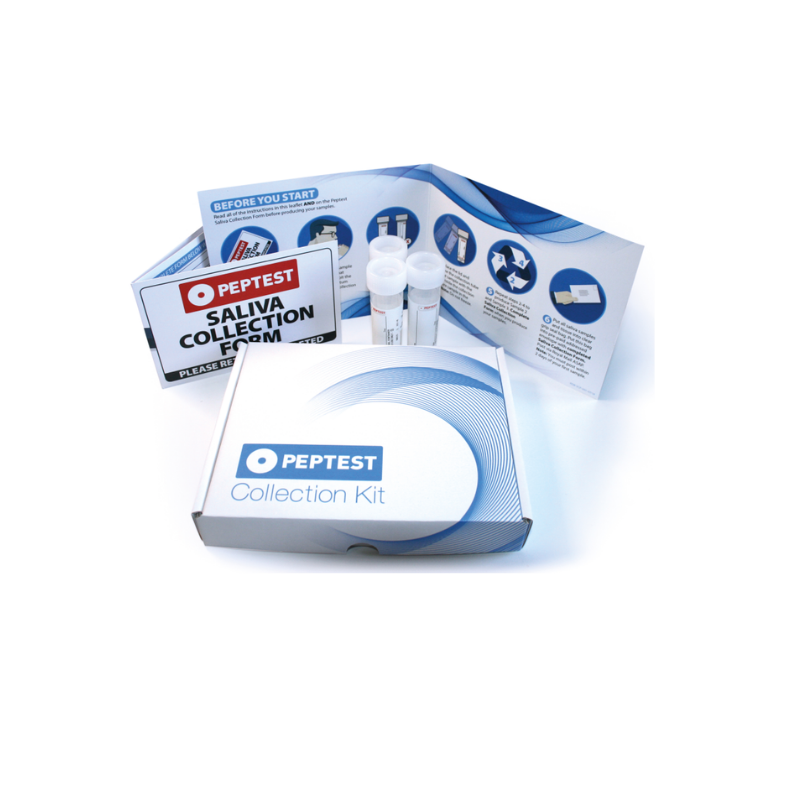
Three timed saliva samples collected by the patient at home using the supplied tubes. Posted to our UK lab in the prepaid packaging included in every kit.
Clinician-ready report
Results returned directly to your practice as a clinician-ready report with positive/negative result and pepsin concentration values across all three samples.
Supports referral
A positive result gives you objective, documented evidence to support a referral to the patient's GP or a gastroenterologist — moving beyond symptom questionnaires alone.
A simple, low-friction workflow for your practice
We work with private dental practices on a straightforward clinic account model. You hold a small stock of kits and hand them to patients — we handle everything else.
Your practice holds starter kits
We dispatch a small starter stock — typically 5–10 kits — to your practice. No setup fees. No minimum order volume.
Identify and test
You identify a patient where reflux may be part of the differential — erosion pattern, soft tissue changes, patient history. Hand them a kit with the patient information leaflet included.
Patient collects and posts
The patient collects three timed saliva samples at home (morning, post-lunch, post-dinner) using the supplied tubes. They post the samples to our UK laboratory in the prepaid packaging provided in the kit.
Report to your practice
We analyse the samples and issue a clinician-ready report, returned directly to your practice. Where consent allows, a copy is also sent to the patient.
Monthly statement
Billing is per submitted test only. You receive a monthly statement. There is no charge for kits held at your practice that haven't been used — kits not submitted within 90 days are classed as depleted at a nominal £10 + VAT handling fee.
Peer-reviewed research relevant to dental practice
The association between GERD and dental erosion is one of the most consistently replicated findings in dental medicine — supported by multiple systematic reviews and meta-analyses. Below are the studies most directly relevant to dental clinicians.
Peptest and soft tissue lesions of the oral cavity
A one-year clinical study evaluating the correlation between Peptest-positive pepsin detection and soft tissue lesions of the oral cavity in patients with GERD. The study found a strong correlation between GERD and oral soft tissue lesions, concluding that Peptest is a decisive aid in early detection.
Prevalence and risk of dental erosion in GERD patients
Meta-analysis of 28 studies involving 4,379 people found dental erosion in over half of GERD patients, compared to 21% of controls. GERD was associated with a fivefold increased risk of dental erosion (OR 5.0, 95% CI: 2.99–8.35) — the largest pooled analysis to date.
GERD and erosive tooth wear: overview of 10 systematic reviews
Reviewed 10 systematic reviews covering the prevalence and association between GERD and erosive tooth wear. Concluded that GERD is a risk factor for erosive tooth wear and that individuals with GERD have an increased probability of presenting with signs of erosion. A multidisciplinary medical and dental approach is recommended.
LPR, GERD and dental erosion: significantly higher prevalence in reflux patients
A systematic review of 22 studies found a significantly higher prevalence of dental erosion in adults with GERD or LPR compared to healthy controls. Subjects with dental erosion also demonstrated greater prevalence of LPR or GERD — reinforcing the bidirectional clinical relationship and the value of reflux investigation in unexplained erosion cases.
50+ studies spanning ENT, gastroenterology, respiratory and basic science
The complete Peptest clinical evidence library includes studies on LPR diagnosis, GERD detection, chronic cough, pulmonary aspiration, non-acid reflux, and pepsin as a biomarker across multiple clinical disciplines — available to download in full.
Recognised at the highest level of UK dental practice
"Dentists are commonly the first healthcare professional to identify systemic disease through its oral manifestations — and should be aware of signs of intrinsic erosion indicative of possible reflux in patients who may have no digestive symptoms."British Dental Journal (2023)
Gastrointestinal conditions related to tooth wear
The 2023 BDJ review places dentists at the forefront of reflux detection — recommending that clinicians question patients about symptoms and initiate appropriate referral where gastro-oesophageal reflux is suspected as a cause of erosive tooth wear. Peptest provides the objective confirmation needed to act on that suspicion.
If you are currently using Peptest in your practice and would be willing to share your experience for a case study, we would very much welcome hearing from you. Please include a note in the contact form below.
UK manufactured. ISO-accredited laboratory. Clinician-ready reporting.
Peptest is a CE-IVD certified in-vitro diagnostic device manufactured by RD Biomed Limited in the UK. All patient samples are processed at our ISO 13485:2016 accredited laboratory in Hull, with results returned to the requesting clinician as a structured report.
Peptest is used in clinical settings across the UK and internationally, and has been evaluated in over 50 peer-reviewed studies spanning ENT, gastroenterology, respiratory medicine and dentistry.
Peptest is also available to dental practices through our UK healthcare distributor, BIOHIT HealthCare — a specialist diagnostics company supplying NHS trusts and private clinics across the UK.


Interested in introducing Peptest to your dental practice?
We work with private dental practices, dental hospitals and specialist clinics. To find out more about the clinic account — including starter kit dispatch, report formats, and pricing — contact us using the details below or use our contact form.
Please mention "dental clinic account" in your message so we can route your enquiry to the right person. We aim to respond within one business day.